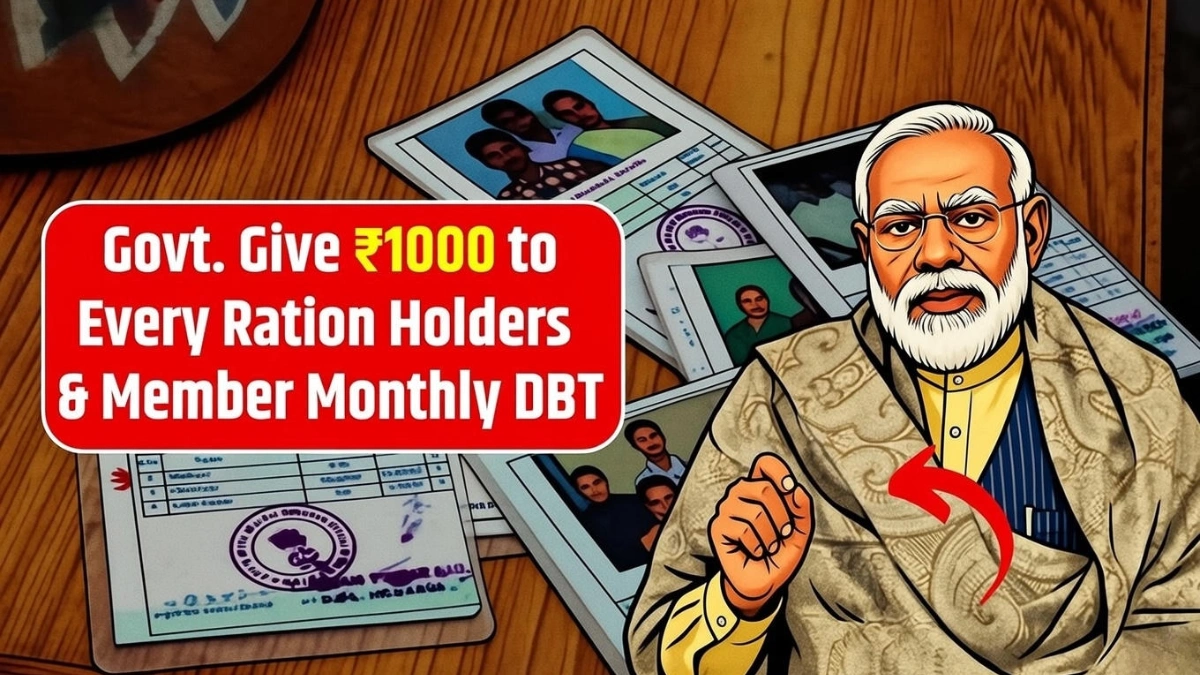
The Indian government is preparing a major welfare reform under the Ration Card system for 2026, with reports indicating a ₹1000 monthly Direct Benefit Transfer (DBT) for eligible families. This move is being seen as a significant step toward strengthening food security and providing direct financial support amid rising living costs.
If implemented nationwide, the reform could benefit millions of low-income households who depend on ration cards for essential support.
What Is the Ration Card 2026 Reform All About
The proposed Ration Card 2026 reform focuses on shifting part of the welfare support from physical subsidies to direct cash transfers. Instead of relying only on subsidized grains, eligible families may receive ₹1000 every month directly into their bank accounts through the DBT system.
The reform aligns with the government’s broader goal of improving transparency, reducing leakage, and ensuring benefits reach the intended beneficiaries efficiently.

₹1000 Monthly DBT: How the Scheme Is Expected to Work
Under the proposed system, families holding valid ration cards and meeting eligibility criteria would receive a fixed monthly amount of ₹1000. The money would be transferred directly to the linked bank account, eliminating middlemen and delays.
This amount is expected to help families manage expenses related to food, cooking fuel, and other daily essentials, especially in urban and semi-urban areas where costs are higher.
Who May Be Eligible for the ₹1000 DBT Benefit
Eligibility is likely to be based on existing ration card categories. Priority households such as Antyodaya Anna Yojana and Priority Household card holders are expected to be the primary beneficiaries. Income limits, Aadhaar linkage, and bank account verification are also expected to play a key role.
Families already registered under the Public Distribution System and DBT-linked welfare schemes may automatically qualify, subject to final government guidelines.

Why the Government Is Moving Toward Direct Cash Support
One of the key reasons behind this reform is efficiency. Cash transfers allow beneficiaries to choose how to use the support based on their real needs. The DBT model has already shown success in schemes related to LPG subsidies, pensions, and farmer support.
By combining ration benefits with direct cash assistance, the government aims to strengthen social security while modernizing welfare delivery.
Impact on the Existing Public Distribution System
The reform does not necessarily mean the end of subsidized ration distribution. Instead, it is expected to complement the existing system. Physical ration distribution may continue, while the ₹1000 DBT acts as additional financial support.
This hybrid approach could provide flexibility and improve the overall effectiveness of food security programs.

When the Ration Card 2026 Reform Could Be Implemented
While no official nationwide rollout date has been announced, reports suggest the reform could be phased in during 2026 after pilot testing in select states. Final implementation will depend on budget allocations, state coordination, and official notifications from the central government.
Beneficiaries are advised to stay alert for official announcements and ensure their documents are updated.
What Ration Card Holders Should Do Now
To prepare for the possible rollout, ration card holders should ensure their Aadhaar is linked, bank account details are correct, and mobile numbers are updated in government records. These steps can help avoid delays or exclusion when the scheme is launched.
Local ration offices and online portals can be used to verify and update details.

Why This Reform Is Gaining Nationwide Attention
The promise of a ₹1000 monthly DBT directly impacts household budgets and addresses cost-of-living concerns. That is why the Ration Card 2026 reform is trending widely across news platforms and Google Discover, especially among low- and middle-income families.
Direct cash support combined with food security is being seen as a powerful welfare upgrade.
Conclusion: The Ration Card 2026 reform, with its proposed ₹1000 monthly Direct Benefit Transfer, has the potential to reshape India’s welfare landscape. By offering direct financial support alongside existing ration benefits, the government aims to provide stronger, more flexible assistance to vulnerable families.
Once officially announced, this reform could become one of the most impactful welfare initiatives of 2026.

Disclaimer: This article is based on reports, policy discussions, and preliminary information regarding the Ration Card 2026 reform. Final eligibility criteria, payment amounts, and implementation details will depend on official notifications issued by the government. Beneficiaries should rely on government sources for confirmed updates.