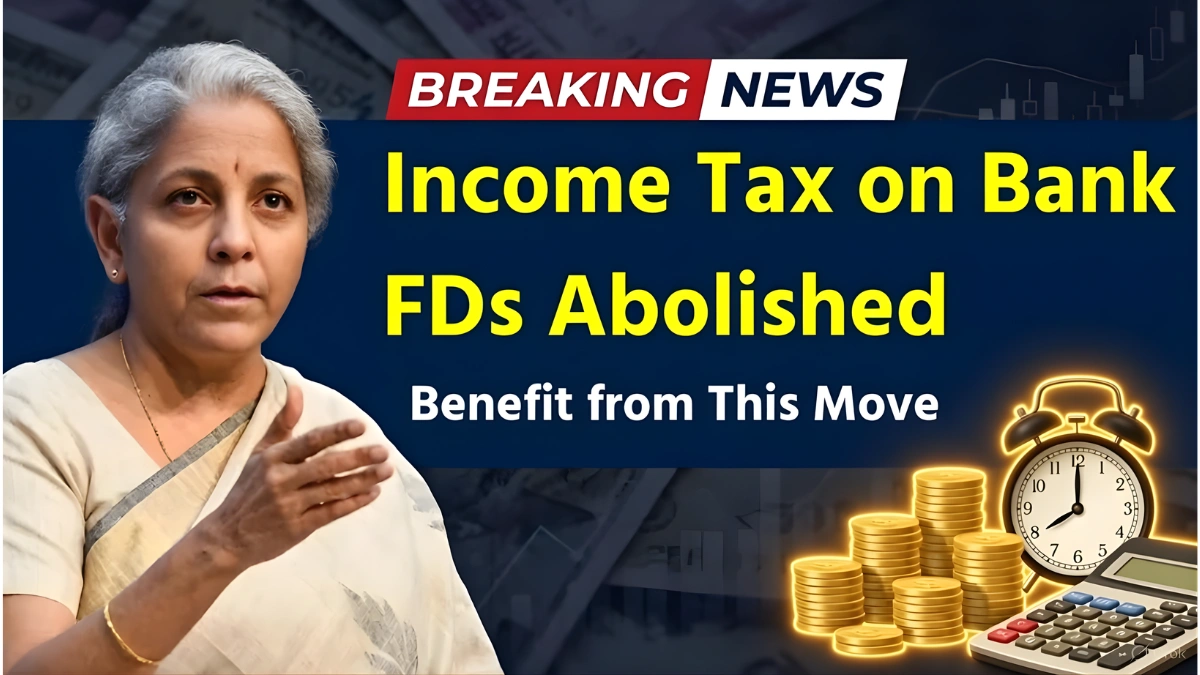
Claims that income tax on bank Fixed Deposits (FDs) has been abolished are creating massive buzz among investors, senior citizens, and middle-class savers. With rising living costs and heavy dependence on FD interest for stable income, even the possibility of tax-free FD returns has sparked nationwide attention. But what is the real truth behind this development, and who stands to benefit if such a move actually happens?
Why the “Tax-Free FD” News Is Trending
Bank FDs remain one of India’s most trusted savings instruments, especially for retirees and risk-averse investors. However, interest earned on FDs is fully taxable as per income slab, which significantly reduces real returns.
Recent policy discussions, reform demands, and financial inclusion debates have fueled speculation that the government may remove or reduce income tax on FD interest, especially for small savers and senior citizens. This has led many to believe that FD tax may be abolished altogether.
Current Tax Rules on Bank Fixed Deposits
As of now, interest earned on bank FDs is added to a person’s total income and taxed according to the applicable slab rate. Banks also deduct TDS if interest crosses the prescribed annual threshold.
This taxation structure affects millions of people who rely on FDs as their primary or secondary income source.

Why Experts Are Discussing FD Tax Relief
There are three major reasons behind the growing demand for tax-free FD interest.
First, senior citizens depend heavily on FD interest after retirement, and taxation significantly reduces their monthly cash flow.
Second, high inflation has reduced real returns from traditional savings instruments.
Third, the government is under pressure to support small savers without pushing them toward risky market products.
These factors have made FD tax relief a recurring policy discussion.
Has Income Tax on FDs Really Been Abolished
As of now, there is no official notification confirming complete abolition of income tax on bank FDs. However, experts believe targeted relief measures are being actively evaluated.
Instead of a blanket exemption, the government may consider higher exemption limits, slab-specific relief, or special treatment for senior citizens and low-income groups.

Any such reform would be implemented under frameworks regulated by authorities including Reserve Bank of India and the income tax administration.
Who Would Benefit the Most If FD Tax Is Removed
If income tax on FD interest is abolished or relaxed, the biggest beneficiaries would be:
• Senior citizens dependent on FD income
• Middle-class salaried families with emergency savings
• Small investors avoiding market risk
• Retirees without pension support
For these groups, net FD returns would increase instantly without any additional investment.
How Much Extra Money Could Investors Save
Removing tax on FD interest would directly boost post-tax returns. For example, a person earning ₹3 lakh annually from FD interest could save tens of thousands of rupees each year, depending on their tax slab.

Over long periods, this translates into substantial financial relief and improved retirement security.
Why the Government Is Being Cautious
While tax-free FDs sound attractive, such a move would also reduce tax revenue. The government must balance fiscal discipline with public welfare.
That is why experts expect partial relief or targeted exemption, rather than a complete nationwide abolition of FD taxation.
Possible Alternatives Under Consideration
Instead of full exemption, policymakers may consider options like higher basic exemption for FD interest, no tax for senior citizens up to a higher limit, or reduced tax rates on long-term FDs.
These measures would still deliver relief while maintaining revenue stability.

What FD Investors Should Do Right Now
Investors should not make financial decisions based on viral claims alone. Until official confirmation arrives, FD interest remains taxable.
However, staying informed and planning tax-efficient investments alongside FDs can help reduce overall tax burden.
Conclusion: While the claim that income tax on bank FDs has been abolished is not officially confirmed, the growing discussion itself signals a possible shift in savings-friendly policy thinking. If any form of FD tax relief is introduced, millions of Indians—especially senior citizens and conservative investors—stand to benefit significantly. Until then, FDs remain safe but taxable, and any real change will only come through formal government notification.
Disclaimer: This article is based on policy discussions and expert analysis. No official government notification has confirmed complete abolition of income tax on bank FD interest so far.
